

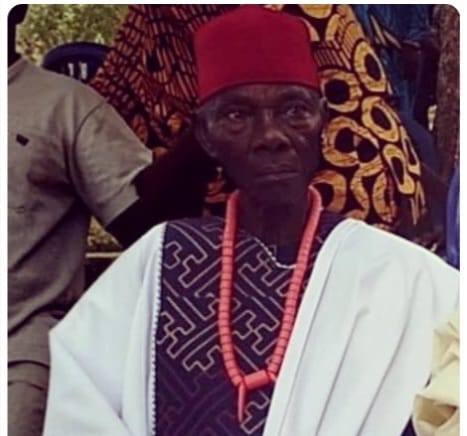
The historic community of Imoga in Akoko Edo Local Government Area of Edo State has installed an 82-year-old retired Nigerian Army officer, Chief Dominic Adesunloye, as its new Daudu, the second-in-command to the traditional ruler and heir apparent to the throne, in keeping with an age-old rotational kingship arrangement that has ensured orderly succession between the community’s two royal dynasties.
Chief Adesunloye, a prominent member of the Ogah Royal Dynasty who served in the Nigerian Army for 32 years before voluntarily retiring, was formally installed on October 5, 2026, following the death of his predecessor, Chief Oluyole John, who joined his ancestors on October 2, 2026.
The installation, which was greeted with jubilation among members of the community, saw the new Daudu ceremonially capped by Chief Olorunfemi Patrick, who performed the traditional rite on the authority of the Ogah Ruling House.
By his installation, Chief Adesunloye becomes the second-in-command to the reigning traditional ruler of Imoga, His Royal Highness, Oba Sir P.C.M. Abudu, Okpahi Bu Ma Obajuoye II, a descendant of the Olumo Royal Dynasty.
In a statement released to Akoko Edo Newspaper on the significance of the installation, the Imoga Palace Secretary, Mr John Olorioke, explained that the position of Daudu occupies a particularly important place in the community’s traditional institution because its holder is not merely the second-ranking traditional authority but also the recognised Oba-in-waiting, who automatically ascends the throne upon the death of the reigning monarch.
According to him, Imoga operates a distinctive and firmly established rotational kingship system under which the throne alternates between two royal families, the Ogah and Olumo dynasties, without the competitive selection processes, rival claims and succession disputes that sometimes characterise traditional institutions elsewhere.
The arrangement, which has become an enduring feature of Imoga’s customary administration, ensures that whenever an Oba from one ruling house joins his ancestors, the throne passes automatically to the serving Daudu from the other ruling house. The family of the deceased Oba then produces a new Daudu, who becomes the next heir apparent, thereby maintaining an uninterrupted cycle of succession between the two royal dynasties.
Mr Olorioke explained that one of the most remarkable features of the Imoga kingship tradition is that succession is neither determined by a contest among princes nor subjected to a fresh selection exercise whenever the throne becomes vacant. Rather, the position of Oba is reserved for the serving Daudu, whose eligibility would already have been established under the customary rules governing his emergence from the appropriate ruling house.
He said the arrangement is so firmly rooted in the community’s tradition that neither of the two royal dynasties contests the other’s entitlement to the throne when its turn comes, while the principle of seniority provides a recognised basis for determining succession within each ruling house.
Under the system, the most senior eligible male member of the ruling family entitled to produce the next Oba ordinarily occupies the position of Daudu. Upon the death of the reigning Oba, he automatically succeeds to the throne, while the family of the deceased monarch identifies its own most senior eligible member to assume the position of Daudu.
The tradition also makes provision for the death of a Daudu during the lifetime of the reigning Oba. In such circumstances, the next most senior eligible male member of the same ruling house steps into the vacant position and remains the Oba-in-waiting until the reigning monarch joins his ancestors, when he automatically ascends the throne.
The emergence of Chief Adesunloye as the new Daudu is therefore significant not only because it fills the vacancy created by the death of Chief Oluyole John but also because it reinforces a succession tradition that has become central to Imoga’s identity and traditional governance.
At 82, Chief Adesunloye brings to his new position a wealth of experience acquired during more than three decades of military service. His 32-year career in the Nigerian Army, which ended with his voluntary retirement, represents a substantial period of national service and provides a background of discipline and organisational experience that could prove valuable in the discharge of his traditional responsibilities.
Community sources describe the new Daudu as a humble and trustworthy elder who has demonstrated a strong commitment to the development and progress of Imoga. His personal qualities, together with his seniority and standing within the Ogah Royal Dynasty, are regarded as important attributes as he assumes his place in the community’s traditional leadership hierarchy.
Community members have expressed their goodwill to Chief Adesunloye, wishing him a long, peaceful and fruitful tenure as he assumes his responsibilities alongside the reigning Oba, whose leadership and that of the Daudu symbolise the continuity of Imoga’s traditional institution.
By Our Correspondent